Tech tree, the embryo
Last changed on
I have started working on the future "tech tree". In the unlikely case you are not aware of what a technology tree is, I suggest you head over to the wiki to learn more about this pervasive element of strategy and tactical gaming.
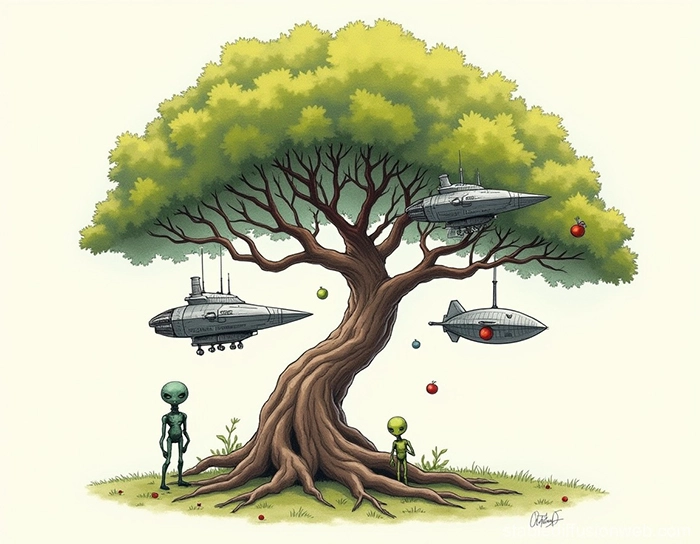
Now I confess that, at the time of writing this, the tech tree has indeed not gotten very far, even though it has seriously slowed my progress on other aspects, notably the 3D explorer (procedural textures, ironing out some floating point precision issues, etc); the reasons for this are multip--ACK
Another… err… thing which is currently taking up quite some time is my teenage daughter expressed a strong interest in building a website, from her own original idea. Now, this idea is not coming out of the blue and there is an excellent reason for it so I offered my full support. Naturally.
Anyway, going back to the problems:
- building a tech tree is inherently hard, especially when both realism and "gamism" are simultaneous objectives;
- in spite of my (ancient although extensive) "Pen & Paper" experience, designing a tree that meets my personal criteria is proving even harder;
- my lack of "game design" experience will likely turn out to be my biggest problem - and at various stages at that: balance, speed, realism, sheer doability and many others are problems that I am currently facing.
A tangent about the future
I mention in several places that Ad Lumens is to become a 4X game. While that is still the case, along with a "real time" aspect, I have been having thoughts along the following lines:
- Classic 4X games are on a huge scale. In a space opera setting, we are talking about empires (or any other political entity/form) spanning hundreds, if not thousands of light years. Not to mention innumerable populations, stations, colonies and ships.
- While this genre is quite and rightly successful, I am feeling the need for something more tactical and closer to some (optional although advised) micromanagement.
- I am thinking of a game start veering on space survival and, as progress is made, gradually moving towards interaction types more commonly found in a 4X game.
- In short, whenever that is supposed to happen, the initial version will likely be about playing a large(ish?) crew of humans thrown about an unknown galaxy to fend for themselves.
Live long and prosper
, they said. :-) - That would mean individual units/humans, as opposed to cities or space stations with borderline abstract and/or aggregated attributes of
SIZE 1orPOPULATION 12; instead, you would know your crew is 208 people strong and growing; you also know what activities they are currently involved in and that they can die of old age/accidents, etc.
I will very likely talk about all this in upcoming posts.
Back to our main subject again: given its status, the tech tree is not ready to be even partly revealed at this stage; in spite of this, I have already encountered some bumps - in more ways than one similar to the questions asked in this post. Where to start? How to design this **?
Bottom-up approach
Like the procedural generation "start at the beginning" approach, starting that the bottom of the tree and designing clawing our way to its top seems like the perfect solution:
- You start with wide families, the trunks, out of which branches are born, then smaller branches, and so on until you reach leaves, the ultimate technologies that can be researched. Let's call them the "dead ends"
- Assuming the trunks were not planted too far away from each other, their branches are likely to intertwine - thus introducing cross-trunk dependencies, which are a good thing from a meta game perspective, as they avoid the "tech tunnel" effect.
- "grafts" will often be artificially created to quite literally "bridge the gap" between one or more branches; this is often done for game balance reasons, and, depending how it's done, can have detrimental or positive effects on the importance/weight of linked technologies and their meta.
I do not pretend to master any of the above points, nor to possess the ultimate solution to the problems they pose. I do know those issues exist because, as a (former) user of such products, I know players look for that chink or crack in the armour of a game's balance. And exploit it. :-)
At least I come prepared. Ish. So I must try and think of a way to make this thing as I want it to be, all the while thinking about meta and the great balancing act. Hum.
So, is the bottom-up approach the perfect solution?
Initially yes, as this approach is a more "natural" simulation: start with basic tech and work/research your way up in the future.
But designing new techs and sciences and the paths/interdependencies between them does not always come easily and quickly. In other words: it is easy to start fantasising about future sciences flowing painlessly and naturally out of one's brain, blanks filling themselves elegantly and quickly and …voilà!. Tech tree complete!
Err… no, voilà pas.
You see, on top of the inherent difficulty of the exercise, my problem is that I would like to build a tech tree that differs from the ones encountered in games such as Stellaris, Master of Orion or Alpha Centauri; don't get me wrong, those games deserve their reputation and success. But I would like to try something slightly different, and that is:
- More granular
- More varied epoch spans
Granularity of technology and science
Given the relative small size of a faction incarnated by a player, I would like to maintain a sense of consistency between the unit size and the science size.
What does that mean? Well, if the smallest unit that can be played in the game is an individual, then it makes sense to avoid a disconnect between that size and the size (or span) of scientific advances: on the one hand, having a very fine one (unit) and a very coarse one (say, laser ->blaster ->disintegrator) on the other - feels odd. What's more, real life is often made of constant small and tiny advances, with the extremely rare major breakthrough once in a while.
Of course this is all easier said than done and some reason needs to be applied (i.e., a science unlocking/discovery should definitely convey a sense or progression!); I will probably run out of imagination and sources of inspiration in many cases. :-)
Epoch spans
Tech trees should cover various epochs or "tiers", going from the fusion age to the (almost) post-physical age. However, such as system should not be artifical and prevent say, Tech A of epoch 3 from being researchable by a faction who has taken the deliberate choice to heavily specialise in a particular field of the epoch 2, while leaving other aspects of the same epoch a bit behind; it should be able to move on to Tech A thanks to that specialisation.
However, and similarly to many games, a "gating mechanism" can be put in place by applying a value of points/token/whatever for each science, based on the epoch to which they belong. For example:
| Epoch 1 | 1,000 points |
|---|---|
| Epoch 2 | 2,000 points |
| Epoch 3 | 4,000 points |
| Further epochs | more points… duh. |
Lastly, epochs can be used to convey a rough sense of advancement reached by another faction/clan. Useful for fluff!
Top-down approach
This approach is the complete opposite and similar to the "start at the end" procedural generation. In a nutshell:
- Don't start with techs/sciences
- Do start with equipment, hardware and the stuff players actually work through research for
Let there be toys
Under this approach, it sounds reasonable to start with the end game and asking the following questions:
- What final toys does the game offer? By final is meant: most practical, cheapest, most damage/defense, fastest, you name it.
- What kind of flavour/fluff does the equipment have? I may be wrong, but suspension of disbelief is important to me, and the end game should feel like an accomplishment both in terms of numbers, but also of immersion.
Ok, so let's start at the end
… and start working our way backwards. Now, even though it may sound obvious, a lot of ground had to be covered:
- The toys' collective capabilities need to cover the scope of scientific advancement in its entirety; this means try to avoid "orphan science" without at least one toy.
- The toys' statistics need to cover all aspects offered by the game engine; this means no game engine statistics or mechanism should be left unmodifiable due to no toy being linked to it. This also means the impact of toys should be reasonably well spread over the game engine mechanics, to avoid meta abuse.
- The toys should have a reasonable justification for their existence in the virtual world; this will favour immersion and that's a good thing.
The second point is particularly important: if a trunk is known to offer more toys than the others, players will have natural tendency to adopt the "more bang for you buck" strategy, go for that trunk and consider the others as secondary.
So it's a fine balancing act:
- Trunks and branches need to be balanced
- Trunks and branches should have different scope/coverage (although overlaps are a must-have), as this would make then bland and uninteresting
- Players/factions should be encouraged to specialise
- Specialisation should of course come with benefits, but also with limitations due to the overlooking of other fields of study
Let's not forget that while you may be the best at manufacturing (and firing!) lasers, your neighbour (whether ally of enemy) might be doing the same for blasters or force shields.
Too much data
I've been spending some time accumulating tech/science/toy ideas using both approaches and have reached the following inventory:
- For the bottom-up approach: around 1,000 "sciences" spread over four main trunks: physics, materials, biology and human sciences
- For the top-down approach: around 4,000 toys, spread from end game to noob level.
The choice of trunks is arbitrary, based on a mix of inspirations: GURPs, Orion's Arm, Master of Orion, Traveller RPG, Sid Meier's Alpha Centauri (SMAC), Spacemaster, Project Rho and many others.
Calling the collection of ideas a tree is very, very premature. :-) Many gaping holes still remain and I am gradually trying to populate them. Sometimes though, a hole is proof that something is wrong and needs rethinking from the start. Which means: cut the branch and grow a new one.
Meeting in the middle
This is a step I have barely begun not really started to tackle. However, it is easy to guess what that step will be about: sticking leaves on branches. In gamer parlance: "what BFGs can I get by researching this stupid science?"
Blueprints
At this point one extra concept needs to be introduced: the blueprint. Or Standard Template Constructs or whatever name will be come up with.
The blueprint concept is interesting: once a faction finally completes a tech/science research, it does not automatically unlock new buildings or units, etc. Instead, it then needs to spend some time on applied science, whose outcome will be one or more blueprints.
A simple summary of the steps that lead to a toy:
| Step | Description |
|---|---|
| Pure science | A node of the tech tree itself. Note that their appearance/availability is slightly randomised (more on this in a future post) |
| Applied science | A "offshoot" of the pure science. Several such "sub-sciences" can exist. Their access is voluntary, i.e., a faction chooses to pursue that path and no randomisation takes place here. |
| Blueprint | This is the outcome of the applied research. The blueprint can be of a variable quality, with factors depending on:
|
| Product | Is the outcome of the manufacturing using the blueprint. Again, some randomness is applied so that some products have a small chance of being inferior or superior. After all, this is not magic. We are talking about autofacs and assembly swarms! Note that products can be reversed engineered and yield a blueprint. |
Blueprints encourage another aspect to gaming on top of exploration, conquest, etc. Some factions may even choose to dedicate their time to applied research and make a decent living out of it.
And there you go! As you can see (if you have managed to read this all the way down to here), this is very much a work in progress! Not an easy one, but extremely interesting and challenging.
Please signin to add your comment.